

 Italiano
 Español
Ogham Alphabet ONLINE SHOP
The Ogham alphabet, this term or Ogham Craobh (tree writing), or Beth – Luis – Nion (from the pronunciation of the first three letters), usually refers to the alphabet of the ancient Celtic languages.
It is thought that “Ogham” means “wise use of the word” and was, originally, a particular form of cryptical writing in which the names of the letters took the place – in some syllables – of the very same letters. Historically, it is believed to go back to around 1700 BC, in the region of Sinai, but its codification has been dated to around 1200 BC. The Ogham writing consists of a series of straight lines engraved on stone or wood. In the last century it was assumed that this kind of writing had been influenced by the Greeks, influence later extended to the Germanic runic art. Moreover, it is a historical fact that for a short time Ogham writing became spoken, since Caesar forbade Druids from using it as a written language.
The oldest evidence of Ogham texts dates back to the V-VI century AD, but this is because in the previous phases this writing was carved on wood and bark, now lost. The inscriptions come down to us (about 380) are mostly vertical funeral steles with the edge of the stone that serves as the midline of writing, and are found in Ireland, Wales and the Isle of Man.
The main feature of Ogham writing is that of not having different letters, obtaining the various signs of the alphabet using an increasing number of different incisions in straight lines (dashes) addressed both right and left, using as a basis the continuous vertical line that acts as a fulcrum. The Ogham alphabet consists of twenty different letters, distributed in four series: each series named after its first letter. The first three series are composed of consonants, the fourth of vowels. Each letter is associated with a particular tree, hence the name Ogham Craobh.
The Tree Calendar
The lunar months (consonants)
The lunar months (consonants)
| Calendar | Ogham Letter |
Tree |
|---|---|---|
| December 24 – January 20 | Beth | Birch (Beithe) |
| January 21 – February 17 | Luis | Rowan (Luis) |
| February 18 – March 17 | Nion | Ash (Nin) |
| March 18 – April 14 | Fearn | Alder (Fern) |
| April 15 – May 12 | Saille | Willow (Sail) |
| May 13 – June 9 | Uath | Hawthorn (Uath) |
| June 10 – July 7 | Duir | Oak (Dair) |
| July 8 – August 4 | Tinne | Holly (Tinne) |
| August 5 – September 1 | Coll | Hazel (Coll) |
| September 2 – September 29 | Muin | Vine (Muin) |
| September 30 – October 27 | Gort | Ivy (Gort) |
| October 28 – November 24 | Ngètal | Reed (Gètal) |
| November 25- December 23 | Ruis | Elder (Ruis) |
The intercalary days (vowels)
| Calendar | Ogham Letter Oghamica |
Tree |
|---|---|---|
| Dicember 25 | Ailm | Silver Fir (Ailm) |
| Spring Equinox | Onn | Gorse (Onn) |
| Summer Solstice | Ur | Heather (Ur) |
| Autumn Equinox | Eadhadh | White Poplar (Edad) |
| Winter Solstice | Idho | Yew (Idad) |
L’Ogham St. Justin
In the pewter pendants of St. Justin’s line, the Ogham alphabet engraved on platelets takes up the idea of associating each letter to its respective tree, simplifying the division in 12 months:
 |
Calendar | Tree |
|---|---|---|
| January | Alder | |
| February | Willow | |
| March | Ash | |
| April | Hawthorn | |
| May | Oak | |
| June | Holly | |
| July | Hazel | |
| August | Vine | |
| September | Ivy | |
| October | Reed | |
| November | Birch | |
| December | Rowan |
Related Celtic SYmbols

Celtic Symbols
The Runes
Celtic Symbols
The Ogham Alphabet

Celtic Symbols
The Triskelion

Celtic Symbols
The Claddagh Ring

Celtic Symbols
Glastonbury – The Chalice Well
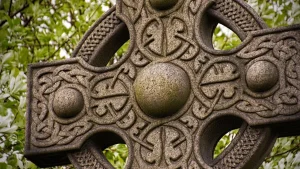
Celtic Symbols
The Celtic Cross

Celtic Symbols
The Pentacle
Celtic Symbols