

 Italiano
 Español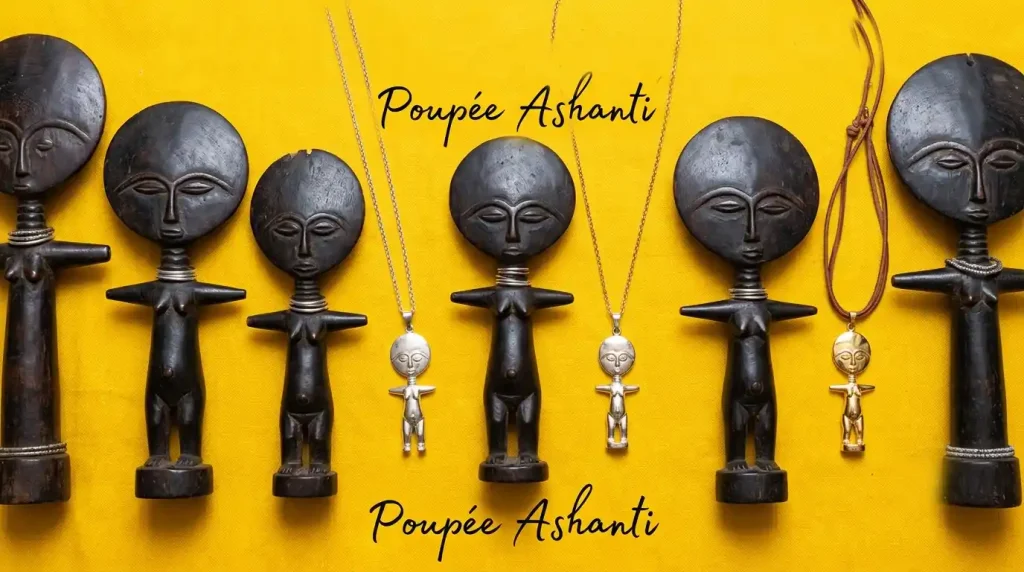
Meaning and Social Function
The Poupèe Ashanti: in all African cultures, the doll has a deep and special meaning, which follows the traditions of the tribe to which it belongs.
The social function of these objects is fundamental and well defined, although it may have different shades from tribe to tribe: female fertility is the basis of African society and is a concept that goes beyond the idea of family. It symbolizes the survival and continuity of the community, therefore in Africa can be found countless fertility cults.

Ashanti dolls, also known as Akwaba or Akuaba, are the most important artifacts that traditionally protect female fertility and favour pregnancy: in the Ashanti tribe, one of the main ethnic groups in Ghana and part of the Akan group, women are the final arbiter of every decision and every choice, therefore it is essential to protect their fertility and pregnancy.
The importance of motherhood is the basis of this culture: women’s social position within the tribe often depends on the number of pregnancies that they managed to accomplish, on the ability to ensure a descent to their husband.
Physical Characteristics and Structure
Ashanti dolls, born as ritual and religious objects, have the important role of protecting pregnancy. Their typical features include:
- Material & Form: Often in carved polished wood, they represent the stylized form of a woman.
- Head: A large flat disc with a high forehead, a flat nose and a small mouth.
- Neck: Held up on a long, thin neck, decorated by a series of rings.
- Body & Base: Body, neck and arms form the shape of a cross, and the base is circular, which allows the dolls to stand without support.
- Details: Small details can differ, such as small optional breasts and more or less protruding abdomens.
Ashanti dolls are worn by women to favour their pregnancy and to ensure the health and beauty of the unborn child: important features are a beautiful head and a long neck; they can be worn as a pendant, or traditionally wrapped in clothes and worn on the back.

The Legend of Akua
Their name comes from the Ashanti and Akan tradition. The legend unfolds as follows:
An infertile woman named Akua, whose greatest desire was to have a child, consulted all tribe chiefs and sorcerers in vain. A priest told her to carve in wood the figure of a child, and to bear it along with her as if it was real. Akua took care of the wooden doll as her own son: she adorned it with pearls and bracelets, carried it with her, bathed it and cuddled it, while the tribe teased her and called the figurine “Akua’s child”. Soon after, Akua became pregnant and gave birth to a healthy little girl, leading other Akan women to follow her example.
Ashanti dolls are still considered today among the most important fertility amulets of African culture: they are made in bronze or wood and decorated with coloured beads, representing a symbol of luck and prosperity.
Ashanti original products on EthnicaRelated African Symbols
African Jewelery
Tuareg jewelry

African Jewelery
The Hand of Fatima in Africa

African Jewelery